How to Answer a Question Without Saying Anything

Answering questions is dangerous.
You might accidentally answer them.
Here’s how to avoid that.
A sarcastic guide for those who prefer control over clarity.
1. Attack the Questioner’s Intelligence
Goal: Make them regret opening their mouth.
Example:
“That question shows a fundamental misunderstanding of how things work.”
Translation: You’re not smart enough to ask this.
Variation:
“If you had followed the earlier explanation, you wouldn’t need to ask this.”
2. Attack Their Motives
Goal: Shift focus from the question to the person.
Example:
“I’m curious why you’re asking this now. What exactly is your agenda?”
Translation: You’re suspicious. Let’s talk about that instead.
3. Question Their Credentials
Goal: Disqualify them from the conversation entirely.
Example:
“You’re not in this field, so you may not fully appreciate the complexities involved.”
Translation: Stay in your lane.
4. Redefine the Question Into Something Easier
Goal: Answer a safer version of the question.
Example:
Question: “Why did costs increase?”
Response: “What’s important is that we remain committed to affordability.”
Translation: Let’s not talk about costs.
5. Use the “We Already Explained” Shield
Goal: End the conversation without ending it.
Example:
“This has already been addressed previously.”
Translation: Go find it yourself. Or don’t.
6. Deploy the Polite Non-Answer
Goal: Sound respectful while saying nothing.
Example:
“Thank you for your feedback. We will take your views into consideration.”
Translation: Nothing will happen.
Advanced version:
“We have noted your concerns.”
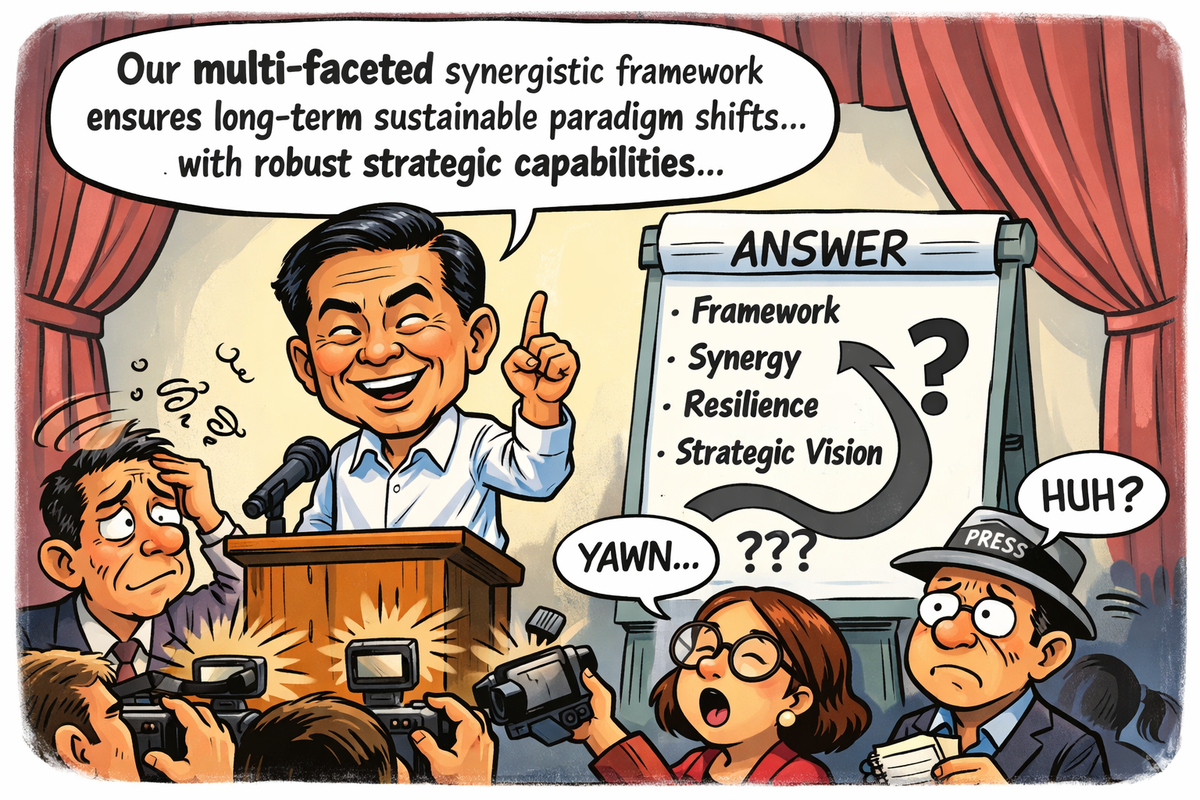
7. Overwhelm With Big Words
Goal: Confuse until the question disappears.
Example:
“We are implementing a multi-layered framework that balances long-term structural resilience with adaptive policy parameters across multiple domains.”
Translation: You’re too tired to continue this.
8. Hide Behind Aggregated Data
Goal: Give numbers that reveal nothing.
Example:
“On average, outcomes have improved across key indicators.”
Translation: Don’t ask for details.
9. Invoke National Interest
Goal: End the discussion immediately.
Example:
“For security reasons, we cannot go into specifics.”
Translation: Conversation over.
10. Turn the Question Back
Goal: Put them on the defensive.
Example:
“What would you have done differently?”
Translation: Now you explain yourself.
If you’re still here, you’re ready for advanced techniques.
11. Praise Them (Strategically)
Goal: Neutralize the tension.
Example:
“That’s a very passionate question.”
Translation: You’re emotional. Not logical.
12. Give Half an Answer
Goal: Appear transparent without actually being transparent.
Example:
“We’ve shared the overall direction and key principles.”
Translation: Details are not for you.
13. Say Nothing, Formally
Goal: Close the loop without closing anything.
Example:
“We acknowledge your query.”
Translation: End of email.
14. Delay Into Oblivion
Goal: Let time solve the problem.
Example:
“We will study this further and provide updates in due course.”
Translation: You will forget this before we do.
15. The Ultimate Move: Answer Something Else Entirely
Goal: Make people forget the original question ever existed.
Example:
Question: “Why did this fail?”
Answer: “Let me share the broader vision of where we are heading as a nation.”
Translation: We are now in a different conversation.
16. Take Immediate Offence
Goal: Make the question feel inappropriate or disrespectful.
Example:
“I take umbrage at the way this question is framed.”
Translation: The problem is not the issue. The problem is your tone.
17. Question the Question Itself
Goal: Make the audience doubt whether the question is even valid.
Example:
“What exactly is the point of your question?”
Translation: You shouldn’t have asked this in the first place.
18. Subtly Attack Their Background
Goal: Undermine credibility without sounding outright rude.
Example:
“Do you have the relevant background to understand this issue?”
Or the sharper version:
“Which school did you come from?”
Translation: You are not qualified to be here.
19. Frame Curiosity as Disruption
Goal: Turn questioning into bad behavior.
Example:
“You’re asking too many questions.”
Translation: Stop thinking. Start complying.
20. Offer the Exit Door
Goal: Shut down dissent completely.
Example:
“If you’re not happy, you are free to leave.”
Translation: We’re not changing anything. You are the variable.
Final Lesson
The question is asked.
A response is given.
Everyone hears words.
And yet… nothing was answered.
That is the art.
Not avoiding the question.
But making people forget what it was.
Got a favorite non-answer from work or public life?
The kind that sounds impressive…
but answers absolutely nothing.
Share it below. Let’s learn from the masters.
Credit: Inspired by a post by Bertha Henson at https://www.facebook.com/share/p/1GyzrYD15Z/
PS If this made you smile… or pause for a moment,
you’ll probably enjoy what I write here:
https://payhip.com/samchoo