Memoir writing tip 3: Write Your Life in Little Pieces

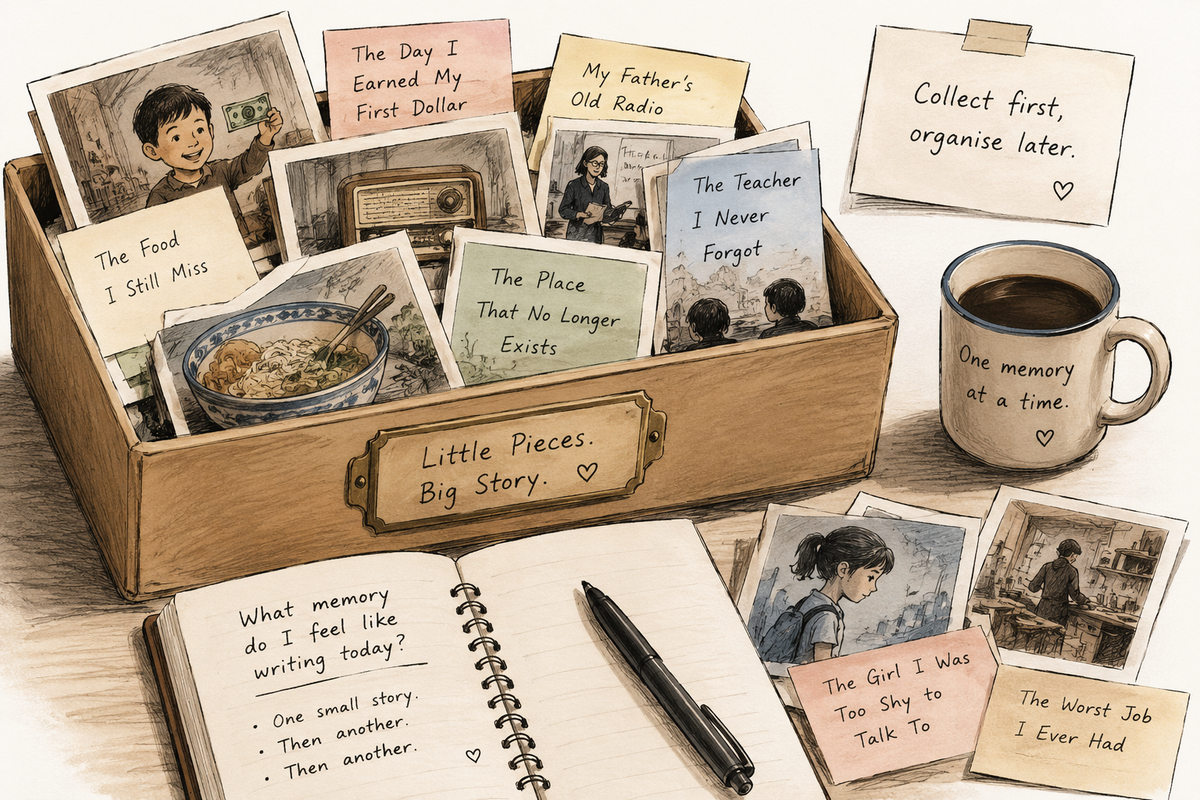
You don't have to start your memoir with, "I was born in..." and then write your life in chronological order.
Sometimes that makes memoir writing unnecessarily difficult. You start worrying about dates, sequence, missing years and what happened before what.
Try something easier.
Write a collection of ordinary, random stories.
Write whatever memory comes to you today.
It could be like the book "Everybody likes Cham' by Verena Chin (find her on Linkedin) or
'The Little Things that Made Me' by Adeline Lee at https://payhip.com/b/ny9kR
These are collection of seemingly small experiences that shaped the person you became.
Or perhaps:
The Day I Earned My First Dollar
The Teacher I Never Forgot
The Girl I Was Too Shy to Talk To
My Father's Old Radio
The Food I Still Miss
The Worst Job I Ever Had
The Lie I Still Remember
The Place That No Longer Exists
There does not have to be any chronology.
One story might be from when you were seven. Tomorrow's story could be from when you were seventeen. The next one might take you back to age ten.
That's okay.
Think of your memoir as a box of photographs. You don't have to arrange the photographs before you can look at them. Pick up one photograph and tell its story. Then pick up another.
This approach makes memoir writing much easier because you only need to answer one question:
What memory do I feel like writing today?
After you have written thirty, fifty or even a hundred little stories, you can decide what to do with them.
You may arrange them chronologically.
You may group them by themes such as family, school, work, friendship, love, faith and growing up.
Or you may deliberately keep them as a collection of seemingly random stories connected by one thing: they are the little pieces that made you who you are.
Don't wait until you know how to tell your whole life story.
Write one small story.
Then another.
Then another.
One day, you may look at the pile and realise:
You have been writing your memoir all along.
This could also become an important philosophy for the whole project: collect first, organise later.