The Cluttered Table Person: How to Read Your Colleague by Their Cubicle (Part 2 of 4)

Every office has cubicles.
And every cubicle tells a story.
Yesterday we met the Empty Table Person.
Today, we step into something more… complex.
Species #2: The Cluttered Table Person
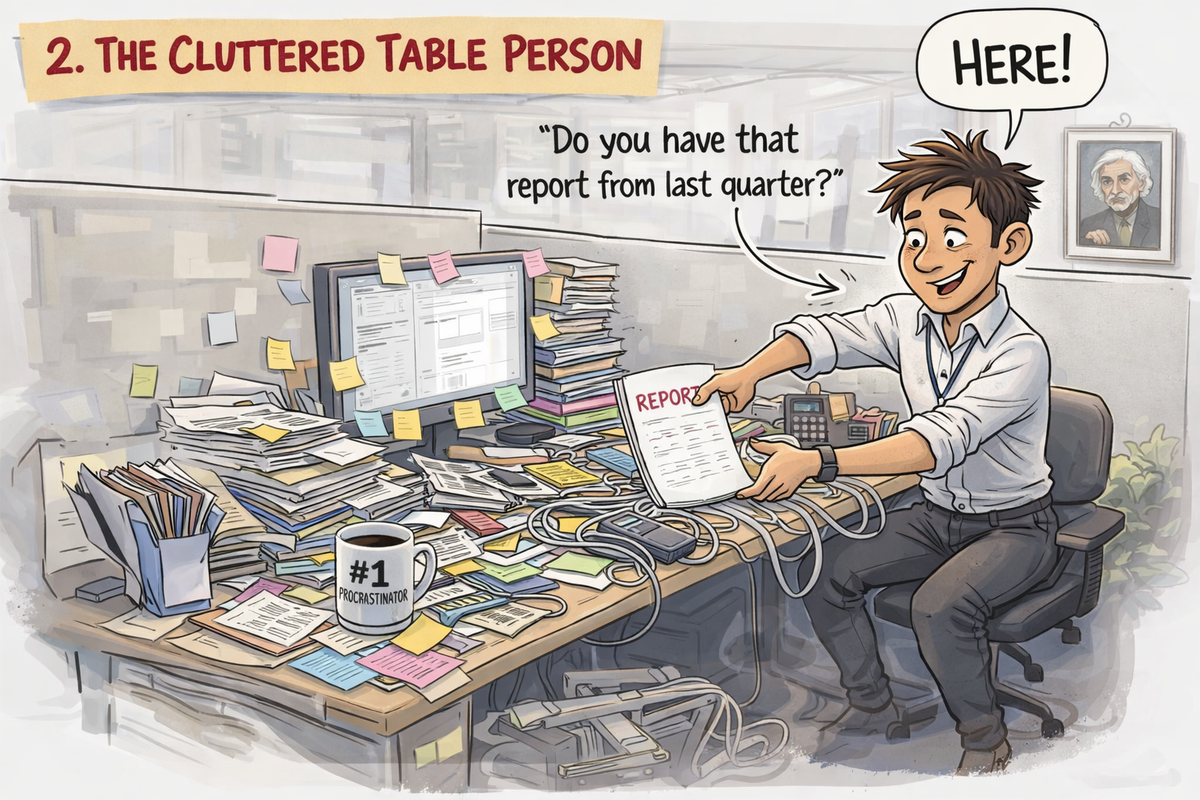
Here’s how their cubicle looks:
Stacks of paper.
Sticky notes layered like geological sediment. The top layer says “Return Carol’s call.” The bottom layer is a reminder for a meeting that happened in the fiscal year 1998.
Pens without caps. Caps without pens.
A mug that has seen things.
There are cables that serve no known purpose, yet if unplugged, would likely cause a blackout in a small neighboring country.
Your first instinct: This person is disorganised.
You ask, “Do you have that report from last quarter?”
They reach into a pile of crumbs and old brochures and, without looking, extract the exact page.
It’s like watching a magician pull a rabbit out of a dumpster.
This is when you realise something important.
This is not mess.
This is a living system.
To outsiders, it looks like disorder.
To them, it is a map of active thinking.
These colleagues process the world differently.
They think in constellations, not filing cabinets.
Their desk is not storage. It is a working memory surface.
They are juggling six things, finished zero, and still the first to spot the solution.
There is a reason this type shows up often in creative and problem-solving roles.
A commonly cited example is Albert Einstein, who was known for having a famously cluttered desk. But not every messy desk belongs to a genius.
Why this matters to colleagues
If you know someone is a Cluttered Table Person, you adjust how you work with them.
Do not judge their capability based on appearance.
They often know more than their desk suggests.
Do not “help” by tidying their space.
You are not cleaning. You are deleting their GPS.
You are committing an act of data corruption.
To them, that leaning tower of folders is a perfectly indexed hard drive.
Move the stapler and you have just corrupted the system.
If you need quick answers in messy, evolving situations, they are often the best people to ask.
They connect dots that others do not even see.
Why this matters to managers
This is where it becomes useful.
These individuals are strong in idea generation, troubleshooting, and handling ambiguity.
They may struggle with rigid systems, strict formatting, or highly structured reporting.
If you force them into tight processes, you reduce their effectiveness.
But if you give them:
Clear outcomes
Flexible methods
Space to think
They produce insights that move the team forward.
The key is not to fix their style.
It is to channel it.
The quiet truth
The Cluttered Table Person is not careless.
They are usually thinking faster than they can organise.
Their desk is simply trying to keep up.
I am curious.
Does your desk look like a natural disaster…
or do you know exactly where everything is?