The Man I Thought Was Foolish

"When I was young, I thought my father was foolish. It took me years to understand what kind of man he really was."
I do not remember the day my father found me.
Everything I know about that day was told to me later.
I was born with spina bifida. My biological parents took me for treatment, but the treatment did not succeed. Eventually, I was left by the roadside.
One day, a man from a village happened to be coming down the mountain.
His surname was Ding.
He saw me.
Perhaps another man would have walked past. Perhaps another man would have thought about the difficulties first. A child like me would need care for years. I could not walk normally. I would probably never be able to work in the way other village children eventually could.
But this man looked at me and saw a child who had been left alone.
He picked me up.
Then he carried me home.
That was how he became my father.
Years later, after I had grown up, one of our neighbours asked me a strange question.
"Do you know how you got your name?"
I told him I didn't.
He explained that I had been passed from place to place until I came to Old Ding. Once I reached him, I was never sent away again.
That was how I became Ding Zhuancheng.
I had finally arrived somewhere I would stay.
My father had very little education. He was a simple village man, and raising a child alone would have been difficult enough. Raising a disabled child alone was something else entirely.
There was no mother in our home to help him.
He had to learn everything.
Years later, someone asked him whether he knew how to change my diapers.
He answered as though the question were almost silly.
"When they were wet, they had to be changed."
Of course he changed them.
He found food for me when there was no milk powder. He carried me. He cleaned me. He fed me.
And when people told him to get rid of me, he refused.
They warned him that I would become his burden.
They told him that his own life would be easier without me.
Some even suggested that he take me into the mountains and leave me there.
My father would not do it.
No matter what people said, his answer remained the same.
"No."
So I stayed.
When There Was Almost Nothing to Eat
We were very poor.
There were times when we had so little food that my father took me to neighbours' houses to borrow something to eat.
I remember one neighbour looking at our situation and telling my father what probably seemed like practical advice.
"Look at yourself. You're already so poor. Why are you still keeping him? Give him up. Then you can go and find work. At least you'll be able to support yourself."
My father did not argue.
He did not give a speech about love.
He simply stopped asking that neighbour for food.
Then he took me away.
That was my father.
He was poor enough to need someone's food, but there were things he would not accept in exchange for it.
One memory from those years has never left me.
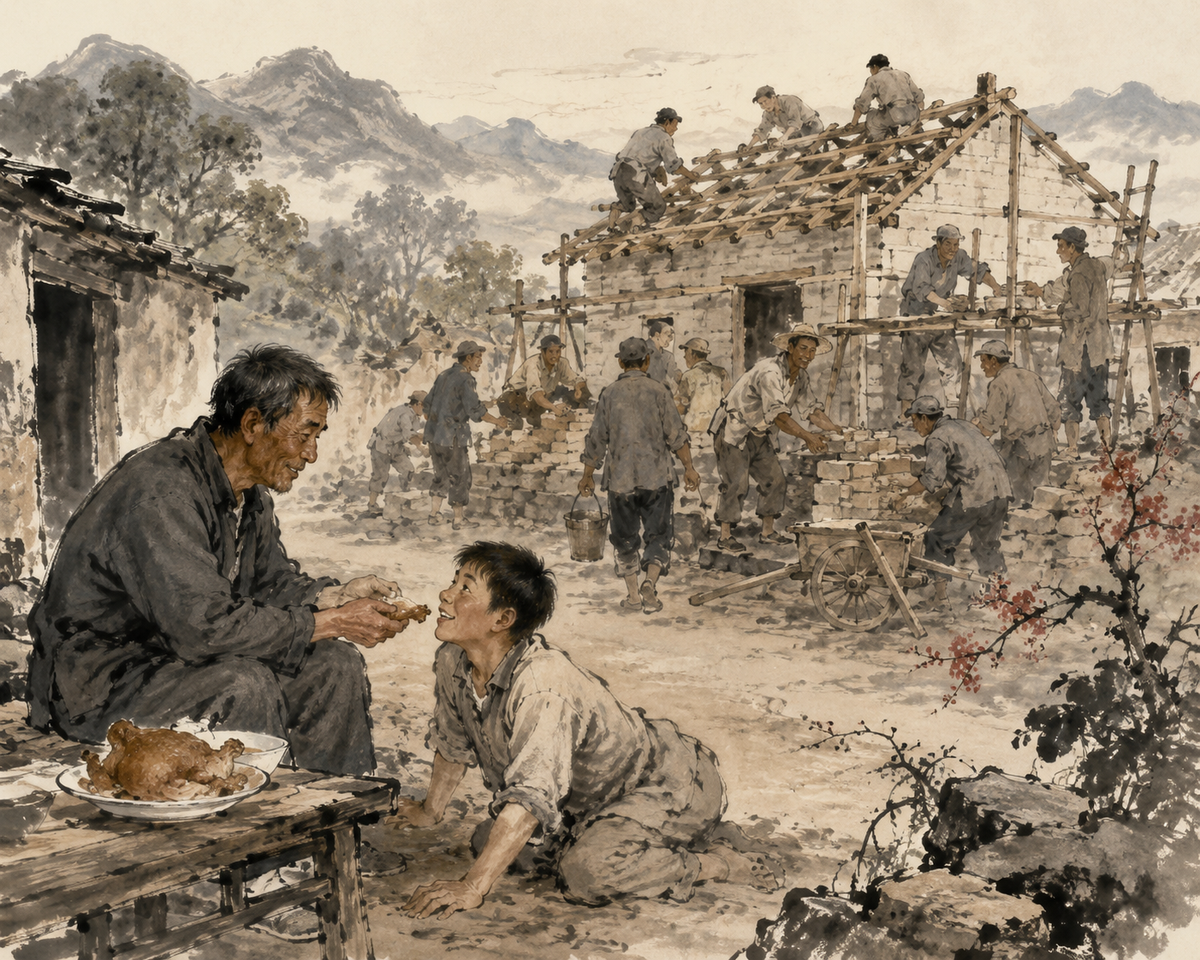
My father had gone to the county town. When he returned, he brought home half a roast chicken.
I can still remember the smell.
I had never eaten roast chicken before. To a child who rarely had good food, it smelled almost unbelievable.
I looked at it and thought, This must be the most delicious thing in the world.
My father broke off a drumstick and handed it to me.
I did not want to take it.
He should eat it, I thought.
We pushed it back and forth for a while. Eventually, as children usually do when faced with roast chicken, I surrendered.
I ate it.
I still remember that chicken as one of the most delicious things I have ever eaten.
Then I noticed my father.
He was eating what I had left behind.
There were tiny pieces of meat still clinging to the bones where my teeth had missed them. My father picked them clean.
I had eaten the drumstick.
He ate my leftovers.
That image stayed with me far longer than the taste of the chicken.
My father always seemed to find a way to give the better things to me.
I Thought My Father Was Weak
There was something about my father that I did not understand when I was young.
I sometimes thought he was foolish.
Perhaps even a little weak.
He was too willing to help people.
There was a man in our village who injured his leg. The man had a son who was already in his thirties, yet he kept asking my father to come and work for him.
My father always went.
This made me angry because my father was not a healthy man himself. He suffered from stomach ulcers.
Sometimes I saw him clutching his stomach in pain, and yet he would still go out to work for someone else.
I worried about him.
I also knew my own limitations.
One day I told him, "Dad, when you don't have anything important to do, please rest. Your health isn't good. If you work until you collapse, I won't even be able to carry a bowl of water to your bedside. How am I going to take care of you?"
He listened.
"All right," he said. "I won't go."
I believed him.
Then night came.
My father quietly left the house and went to help the man plough his field.
What could I do with someone like that?
To my younger self, it made no sense.
Why help people when you yourself have so little?
Why work for someone else when your own stomach hurts?
Why keep giving when life has given you so little?
I thought perhaps my father simply did not know how to say no.
Years later, I discovered that I had misunderstood him.
The One Thing He Would Not Let Me Do
When I was sixteen, I began thinking seriously about helping my father.
He had carried me for so many years. I wanted to carry some of his burden.
So I went into town looking for work.
I thought I might learn to repair mobile phones or electrical appliances. I was willing to learn.
But there was a problem that followed me everywhere.
Because of my disability, I moved by crawling along the ground.
People saw me before they saw what I might be capable of doing.
They did not like the way I looked.
Nobody wanted to take me in.
Nobody wanted to teach me.
Eventually, a friend suggested another way to earn money.
He travelled around and had seen disabled people begging.
"You won't earn much," he told me, "but at least you'll make enough to survive."
I thought about it.
Then I went home and told my father.
He refused.
His reason surprised me.
"Other people's money doesn't come easily either," he said.
We were poor.
My father had borrowed food to feed me.
He had eaten meat from the bones I left behind.
He suffered from stomach ulcers and still worked.
Yet even in poverty, he believed there were ways of getting money that we should not accept.
I began to realise that my father was not a man without opinions.
He had rules for himself.
He simply did not announce them.
The House the Village Built
For many years, we lived in an old tiled house.
The roof leaked when it rained.
Then, eventually, a new house was built for us.
Something happened during its construction that changed the way I saw my father.
People from the village came to help.
We did not hire most of them.
They simply came.
The skilled craftsmen, such as the bricklayers, had to be paid because that was their profession. But many of the ordinary villagers who carried things and did the general labour refused to take wages.
They volunteered.
One after another, they came to help build the house of Old Ding.
Standing there, watching them, I began to understand something that had taken me years to see.
I remembered all those times my father had helped other people.
I remembered the man with the injured leg.
I remembered my father holding his stomach because of his ulcer and still going out to work.
I remembered how irritated I had been with him.
Why are you helping them?
Why don't you look after yourself?
Why can't you say no?
As a boy, I had thought my father was foolish.
Now the village was helping build his house.
Perhaps they remembered things I had forgotten.
Perhaps one man remembered a field my father had helped plough. Another remembered a difficult day when Old Ding had appeared without being asked. Someone else may simply have remembered that whenever help was needed, this quiet man tended to show up.
My father had never kept accounts.
Apparently, the village had.
That was when I finally understood him.
His kindness was never weakness.
He knew exactly what he believed.
He would give his labour freely, but he would not allow his disabled son to beg.
He would borrow food when his child was hungry, but he would walk away from anyone who suggested abandoning that child.
He would eat the scraps left on a chicken bone so his son could have the drumstick.
He had almost nothing.
Yet somehow, he always found something to give.
For years, I had looked at my father and seen a simple village man who was too kind for his own good.
I had been looking at him with the eyes of a child.
Today, I see him differently.
I see the man who found an abandoned disabled baby beside the road and carried him home.
I see the man who heard people tell him that the child would ruin his life and answered with one word.
"No."
I see the man who became a father without knowing how to be one and learned anyway.
And I see a village coming together to build his house.
People sometimes ask whether my father is an extraordinary man.
He would probably give a very simple answer.
He has always been a man of few words.
But I know my answer now.
My father was never foolish.
I simply took a long time to understand what wisdom looked like.
Author's Note
This memoir is based on the true story told by Ding Zhuancheng and his adoptive father during a television interview in China. Their words have been translated, edited and reconstructed into a first-person narrative for clarity and readability while preserving the events and meaning of their story.