Riding the Line

My name is Farid. I live in Johor Bahru, but my days belong to Singapore. Every weekday, my loceng—the alarm—screams at 4:30 a.m. I don’t wake up to the sun; I wake up to the cold reality of the Second Link crossing.
By 5:00 a.m., I am on my bike. The air is damp, smelling of wet asphalt and early mist. I grab a kopi o bungkus from the roadside stall, the heat stinging my fingers through the plastic bag. I swallow it in a few gulps, feeling the caffeine hit a stomach that isn't yet ready for food. Inside the house, my wife and son are still asleep. I don’t go back in to kiss them. I don’t want to bring the smell of asap—exhaust fumes—into their dreams.
My salary is about SGD $2,600. With overtime, it touches $2,900 on good months. In Malaysia, I was stuck at RM 3,000. On a calculator, the math is beautiful. On paper, I am a success story.
But paper doesn’t have to breathe in the fumes.
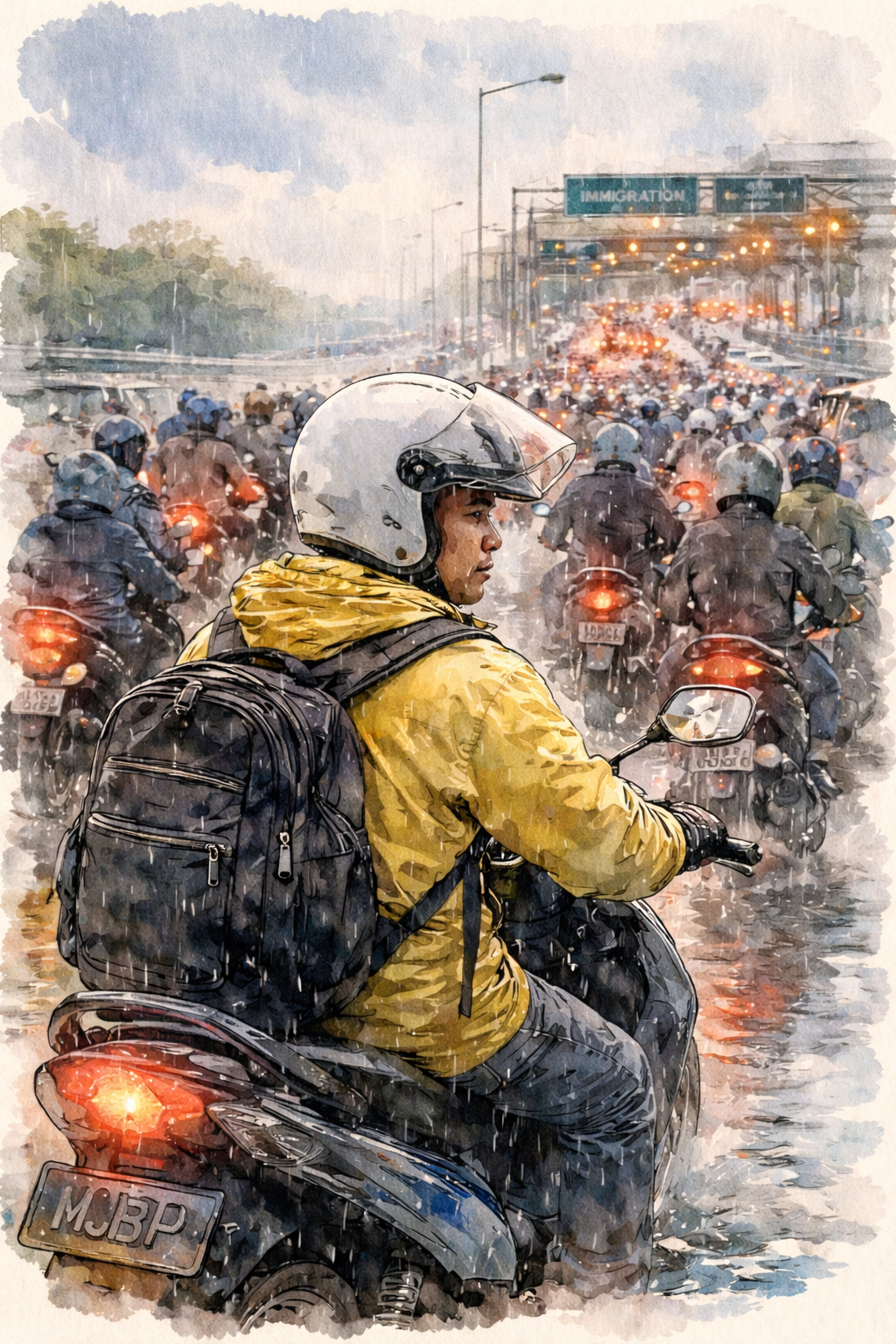
The ride to the checkpoint is a short fifteen minutes. After that, I enter the "Sea of Helmets." Thousands of us, motor kapchai, shoulder to shoulder, inching toward the Tuas lights. We move like a slow, metallic river. The engine heat rises between my legs, mixing with the humidity until my skin feels melekit—sticky and grimy. You don't speak to the riders next to you. We all stare straight ahead, eyes heavy, vibrating in sync with our machines.
On a "good" day, I reach the warehouse in Tuas in an hour and 45 minutes. On a bad day, it’s nearly three.
Then there is the rain.
When the clouds burst over the bridge, the world turns grey. We don't stop. There is no rehat. We pull over under the flyovers—a desperate huddle of neon raincoats—then we dive back into the flood. The water seeps through my sleeves, cooling the engine heat but settling deep into my bones. Visibility drops, and the road becomes a mirror. I ride with my heart in my throat because if I stop, I’m late. If I’m late, the rezeki—my hard-earned livelihood—is at risk.
I spend eight to ten hours in the warehouse. Receiving, scanning, lifting. It is honest work, but my mind is always on the clock. Not because I want to leave work, but because I am calculating the journey home.
The 6:00 p.m. journey back is the hardest. The exhaustion isn't just in my muscles; it’s in my bones. The bridge feels longer in the dark. My back aches, and my hands stay curled like I’m still holding the throttle. By the time I clear the kastam and pull into my driveway, it is 9:00 p.m.
The house is silent.
I stand in the doorway of my son’s room. I smell the baby powder and the faint scent of the dinner I didn't eat with him. There is a new drawing on his desk or a toy moved to a different corner—small evidences of a day I wasn't there to see.
Every day, I spend four hours in the "in-between."
People tell me, "Farid, you're lucky. Makan Singapore Dollars, spend Ringgit. You’re building a future." I nod. I don't argue. I am building a future. The money goes to his school, to my parents' medicine, to a house we will one day own.
But I am paying for that house with the only currency that never renews.
Once, my son asked me, “Papa, why you always riding?”
I laughed and told him I was chasing duit for his toys. I made my fingers walk toward him like little legs and he squealed. He smiled, satisfied.
But that night, after he slept, I sat in the dark for a long time before I looked at my hands. When I finally did, they were stained with oil and trembling slightly from the vibration of the bike — the shaking that never fully stops.
I am not just crossing a border. I am trading the sound of my son’s laughter for a stronger exchange rate.
And as I sit there in the dark, waiting for the 4:30 a.m. alarm to do it all over again, I wonder: when the house is finally built, will I even recognize the people living inside it? Or will I still be just a ghost, pening from ride, forever stuck somewhere in the middle of the bridge?
PS This is a work of fiction inspired by real experiences. It reflects the shared realities of many individuals, but does not represent any specific person.