Same Face, Different Place

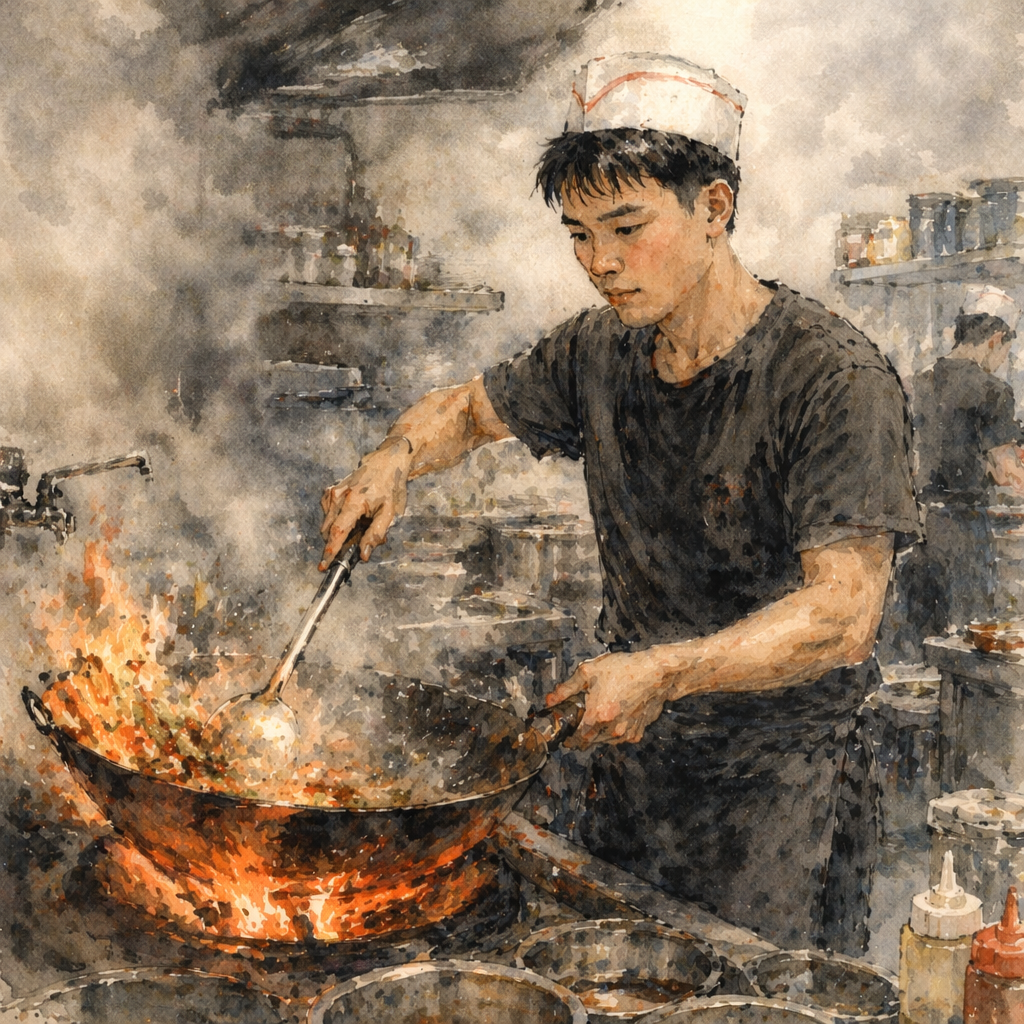
My name is Li Wei. I am from a small city in Fujian. When I first came to Singapore, I thought it would feel familiar. Same face, similar language, similar food. I told my mother, 很快就适应了, don't worry. I believed that.
I work in a mid-sized restaurant near Bugis. My basic salary is SGD $2,600. On paper, it sounds decent. But my shift starts at 10:30 in the morning and ends around 10:30 at night, six days a week. That is about 72 hours a week. Sometimes more if someone calls in sick. There is no overtime pay. The boss says, "F&B is like that."
My hands and legs have stopped hurting. I think that is called adaptation, but it feels more like forgetting.
Expenses come quietly but steadily. I share a room with two other men in Jurong. Rent is $500. Food, even with staff meals, is about $300 a month. Transport $120. Phone bill $30. I send at least $1,000 back home every month. After everything, I save about $500 if nothing unexpected happens. Some months less. 有时候想想 — it feels like I am running every day but staying in the same place.
The first shock was not the work. I expected long hours. The shock was people.
Customers speak fast. English mixed with Singlish. "Can faster or not?" "Don't blur leh." At first I could not catch what they were saying. I smiled and asked them to repeat. Some were patient. Some were not.
One night during dinner rush, a man at the counter was speaking to his friend. "Now everywhere also China people. Mala shops all over already." I was standing right there, holding two bowls of noodles. I kept my face still. My colleague looked at me for a second, then looked away. That look — half sympathy, half relief that it wasn't directed at her — stayed with me longer than his words did.
Another time, I missed a few words in a customer's order and asked him to repeat. He sighed. "You come here work cannot speak English?" I nodded and said sorry. I held the order slip for a moment after he left. I was not angry. I was something smaller and harder to name.
Back home, we speak directly. If something is wrong, we say it. Here I learned there is another way. Soften the words, smile, don't sound too straight. My supervisor once told me, "You cannot talk like you scolding people." In my mind, I was just speaking normally. 真的有点不习惯.
The people I work with are kind. A Malay uncle in the kitchen taught me to say terima kasih and laughed when I mispronounced it. An Indian cashier shares snacks during break. I am grateful for this. But there is something I have taken longer to admit: the distance I feel is not always from the rude customers.
Sometimes it is from the colleagues who are warm to me, who include me, who would call me a friend — and with whom I still feel, underneath everything, like a guest who has stayed slightly too long. I don't know if they feel it too. I don't know if I am imagining it. 真的说不清楚.
On Sundays I go to Chinatown. I eat $6 noodles that taste similar but not exactly the same. I call my parents on WeChat. My mother always asks, 累不累? I always say, 还好. If I tell her the truth, she will worry. So I give her the easier answer.
The first time I sent $1,000 back, my father told me they fixed the leaking roof. I read that message many times. That night, even though my legs were sore, I felt lighter. I track my life in a small notebook like a business ledger — hours traded for shingles on a roof.
After closing, sometimes we sit together and eat what is left. We mix languages, joke, complain about customers, laugh at small things. In those moments I feel normal. Just another worker trying to get through the day.
有时候我会问自己 — how long will I stay?
I do not have an answer yet.
For now, I wake up, put on my uniform, and step into the kitchen heat again. Because somewhere far away, there is a house with a repaired roof, and two people who believe I am doing well. And maybe, for now, that is enough.
PS This is a work of fiction inspired by real experiences. It reflects the shared realities of many individuals, but does not represent any specific person.