The Woman Who Raised Other People’s Children

“I learned how to cook pork adobo from YouTube,” Ma’am once told her friends proudly during a dinner party.
I was standing behind them holding a plate of sliced oranges.
I almost laughed.
For nine years, I was the one cooking it.
My name is Teresa. I came to Singapore when I was twenty-nine with a borrowed suitcase and a secret I did not tell the agency.
I was leaving behind two sons and a husband who gambled harder than he worked.
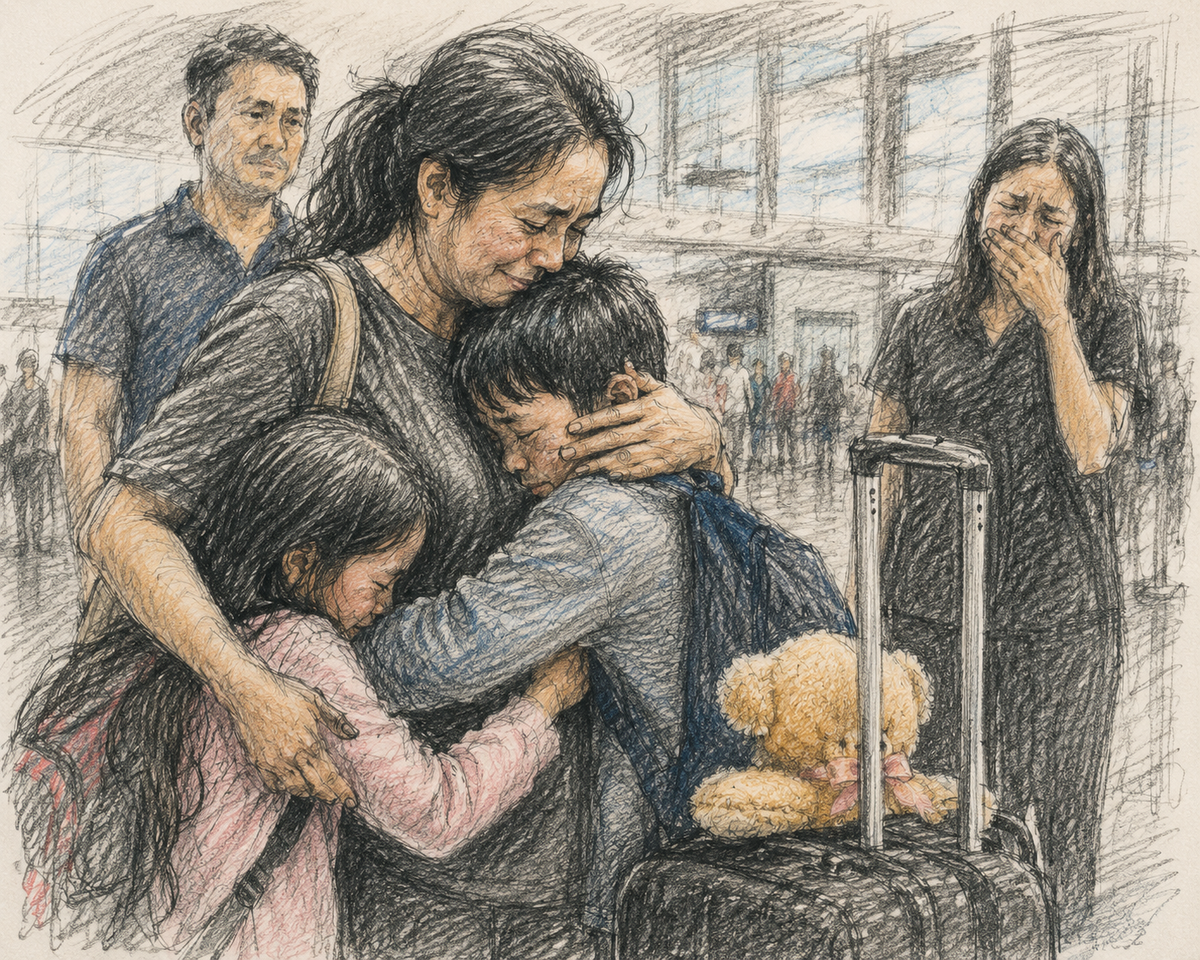
At the airport in Manila, my younger boy hugged my leg and asked, “Mama, when are you coming home?”
I told him, “Soon.”
That was in 2015.
He is now taller than me.
The funny thing about being a domestic helper is that you slowly become invisible and essential at the same time.
Like Wi-Fi.
Nobody notices you until you stop working.
Every morning, I woke up at 5am before the family. I packed lunch boxes, ironed uniforms, and argued quietly with the rice cooker that only worked if you kicked the side once.
The children grew around me like plants.
Ethan used to cry every Monday because he hated spelling tests.
His sister Chloe refused to eat vegetables unless I called broccoli “small trees.”
I learned these things the way mothers do. Slowly. Repeatedly. Without applause.
One night, around 2am, Ethan had a high fever. Ma’am and Sir were overseas in Tokyo. I carried him downstairs to the taxi stand because I could not book Grab with my old phone.
At the clinic, the doctor asked, “Mother?”
I opened my mouth to explain.
Ethan answered first.
“Yes.”
The doctor nodded naturally.
I did not correct him.
That moment stayed inside me for years.
Not because I wanted to replace his mother. I never did.
But because for one exhausted second, the world believed I belonged to someone.
Sundays were my escape.
Lucky Plaza smelled like perfume, fried chicken, and homesickness.
We laughed loudly there. Helpers always laugh loudly together. Maybe because the rest of the week we speak softly.
One Sunday, my friend Jenny showed me Facebook photos of her daughter’s graduation.
Everyone was smiling.
Jenny suddenly cried while eating halo-halo.
Not dramatic crying. Quiet crying.
The dangerous kind.
She whispered, “My daughter hugs her aunt now when she has problems.”
None of us knew what to say after that.
So we ordered milk tea.
Filipinos survive tragedy with sugar.
The twist in my story came during COVID.
The family was trapped at home for months. No school. No office. No escape.
For the first time, they saw what I actually did.
Sir watched me clean the kitchen three times a day while helping Chloe with math homework and calling the plumber and calming Ethan during online classes.
One afternoon, Ma’am entered the kitchen while I was eating leftover fried rice alone.
She stood there awkwardly and asked, “Teresa… what are your boys’ names again?”
Again.
Meaning she had forgotten the first time.
I looked at her and suddenly realized something painful.
I knew her children’s blood types.
She did not know my sons’ names.
“Gabriel and Nico,” I said.
That night, she asked to see their photos.
It was the first real conversation we had in six years.
A month later, my older son messaged me from the Philippines.
“Mama,” he wrote, “thank you for sacrificing.”
I stared at the screen for a long time because sacrifice was not the word I used in my head.
Sometimes it felt more like disappearance.
Last year, I finally went home for good.
At Changi Airport, Chloe cried so hard her mask became wet.
Ethan handed me an envelope before immigration.
Inside was a drawing from years ago.
Stick figures.
Their family.
Sir. Ma’am. Chloe. Ethan.
And me.
Not in the background.
Not beside the luggage.
Right in the center holding everyone’s hands.
Children tell the truth adults take years to understand.
P.S. This story is not included in my book, The City That Isn’t Home: Stories of Work, Distance, and Belonging in Singapore.
The book contains a collection of intimate fictionalized stories inspired by the lives of foreigners, migrant workers, expats, and people living quietly at the edges of Singapore society. Stories about loneliness, sacrifice, survival, dignity, love, homesickness, and the invisible emotional cost of building a life far from home.
If this story moved you, you will probably connect deeply with the others.https://payhip.com/b/vMaQq